Preparing study materials from a recorded lecture is a good example of work that generative AI has simplified substantially in a short time. Two years ago, I manually moved the recording, transcript, slides, and three core prompts between separate tools. Today, one instruction can turn a recording and its slides into a checked summary, material discussed beyond the presentation, a glossary, and a finished PDF for students.
Two years ago, I had a working process that would feel almost archaeological today. I recorded a lecture, had it transcribed, opened ChatGPT in a browser, and inserted the transcript. Then came three core prompts: one for the lecture summary, one for material discussed beyond the slides, and one for the glossary.
The result was a chronological lecture summary, an overview of material discussed beyond the slides, and a glossary for students. The output was useful. Reaching it required a manual pipeline in which I acted as the integration layer between separate services.
Three prompts that worked
The manual process had one advantage: I could see what happened at every stage. The transcript remained separate from the slides, so the actual chronology of the lecture was preserved first. The presentation then helped correct technical terms and distinguish additions made during the class from content that students already had in the PDF.
Unfortunately, every lecture required the same mechanical steps. Upload a file, download the transcript, move the text, attach the slides, manage the prompts, and finally turn the result into a document. That was manageable for one lecture. Across an entire semester, the need for automation became obvious.
From a talk to a prototype
In September 2025, I presented this process at AI Monday Plzeň. In November, I also spoke about AI in higher education at AI Days at the University of West Bohemia. By then, the workflow had moved beyond a private experiment: I was using it in teaching and could describe both its benefits and the places where human review was still necessary.
The next step came with students at AimtecHackathon 2026. Our prototyping led to uTeach AI, which guides users from a recording through transcription and summarisation to export. The processing itself uses small, locally run language models.
The web application showed that the entire process could be packaged into one tool. It still required a dedicated interface and a predefined workflow. Meanwhile, tools capable of assembling and carrying out processes from written rules were developing quickly.
A side product from Oxford
During an agentic AI workshop in Oxford, I showed people outside IT how they could use Codex in practice. I needed the agent to submit a recording to UWebASR reliably, wait for the result, and return the transcript in the required format.
That need produced the public UWebASR Client & Skill. A step I had previously carried out by hand gained a defined interface and a set of rules. An agent can now use it as a tool without requiring the transcription details to be explained again for every recording.
From there, the AI lecture summary skill was a short step. It combines the transcript, the complete slide deck, content-synthesis rules, and checks of the resulting PDF. The workflow also verifies that the document contains all its text, displays its characters correctly, and has no cropped pages.
One sentence instead of a manual pipeline
The folder only needs the recording and a corresponding PDF slide deck. The whole process can then start with one instruction:
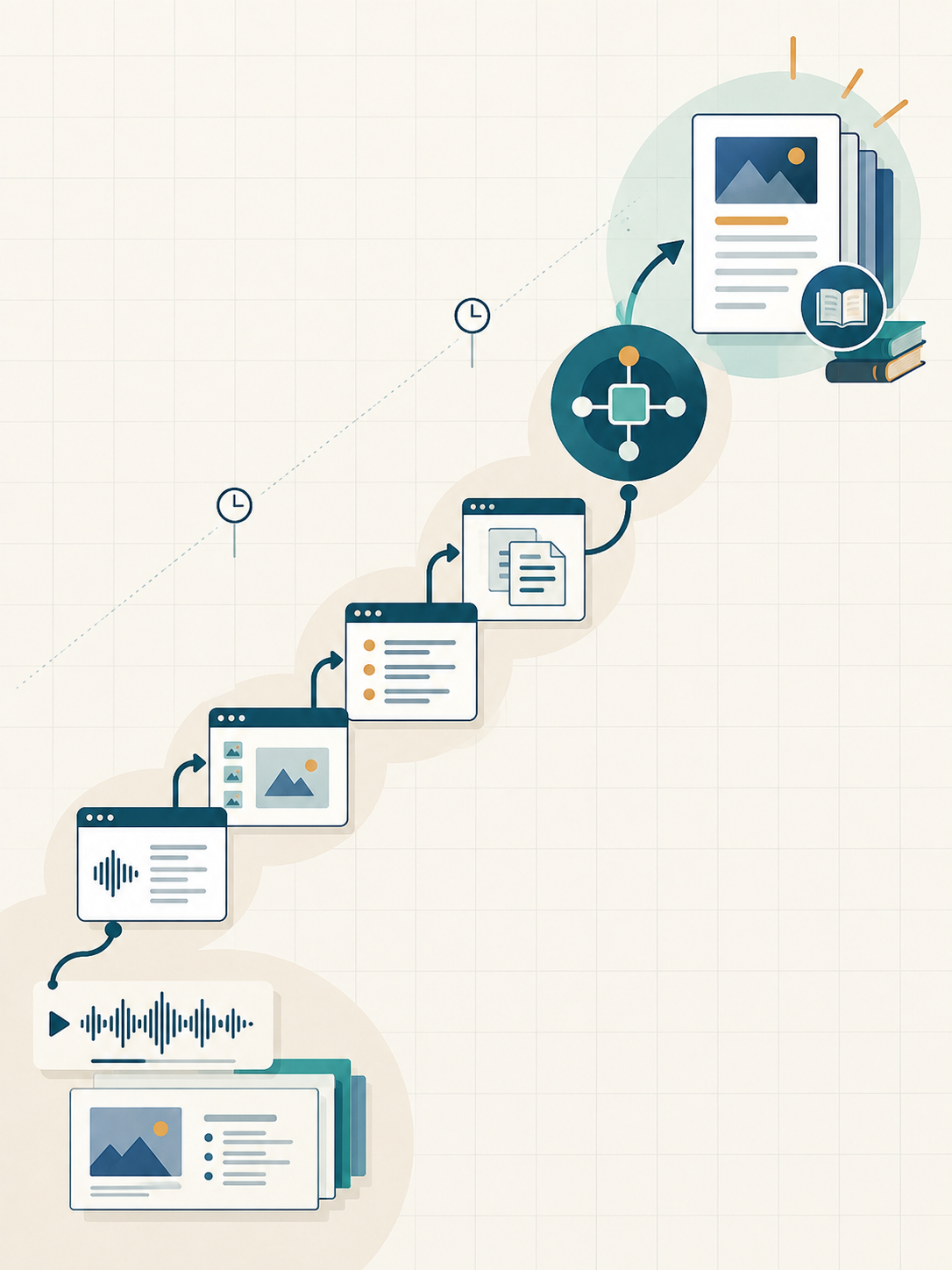
Use $ai-summary-prednasek on 2026/01/ite01.mp3. The recording is in English.The agent, OpenAI Codex in my case, finds the slides with the matching filename, confirms them before starting, transcribes the lecture, and processes both the complete transcript and the presentation. The result is a Markdown file and a PDF with three clearly separated sections: a summary of the main points, material discussed beyond the presentation, and an alphabetical glossary.
Review still has a place in this workflow. Speech recognition may distort a technical term, a model may classify a point incorrectly, and recording a class has its own privacy requirements. The difference is that I no longer have to reconstruct the repeatable steps, formatting, and technical checks by hand.
Two years is a long time in AI
Looking back, this sequence feels like several generations of tools. It unfolded in only two years: from copying material between websites, through a student prototype using local models, to an agent that performs the complete process from one instruction.
The intended output has barely changed. I still want to give students a clear summary, capture important digressions from the lecture, and explain terms that may stand in the way of understanding. What changed most was the route to that material.
Do you already record your lectures?
Links
- uTeach AI: A web application that takes a recording and supporting documents through transcription and summarisation to an exported study guide.
- UWebASR Client & Skill: A public Python client and skill that makes UWebASR transcription available to agentic tools.
- AI lecture summary skill: A public skill for processing a lecture recording and slides into a Markdown and PDF study guide.
- AI-Directed Teaching: What Works and Where Are the Limits?: The AI Monday Plzeň talk about the original manual workflow, its benefits, and its practical limits.
- Agentic AI for Digital Humanities: Materials from the Oxford workshop on agentic workflows, tools, and intermediate-result checks.
- Mentoring at the 10th AimtecHackathon: The context of student prototypes, local language models, and mentoring at AimtecHackathon 2026.