Generative AI can turn a lecture into additional learning support, help students practise and give teachers another perspective on their own materials. At AI Monday Pilsen #7 on 1 September 2025, I presented my workflow from a recording and UWebASR transcript to a chronological summary, topics discussed beyond the slides, a glossary and an experimental Custom GPT. The talk also covered practical limitations: input quality, human review, privacy protection and limited feedback about how students use the chatbot.
Generative AI creates several practical opportunities in teaching when it receives useful source material and its output is reviewed. At AI Monday Pilsen #7, I presented the workflow I use to prepare additional learning materials for university lectures. The talk started at 19:00 on 1 September 2025 in the Plzeňka restaurant lounge and continued with an active audience discussion.
From a recording to learning materials
My lectures deliberately extend beyond the slides. Students can find the core facts in the PDF, while the live session leaves room for current topics, questions and wider connections. These parts are often valuable and difficult to capture in handwritten notes.
I therefore record the lecture and convert the audio into text with UWebASR. The transcript contains errors, especially in English technical terms, library names and method names. During subsequent processing, a language model can use domain context to produce a chronological lecture summary, a list of points discussed beyond the slides and a glossary.
The order of the steps matters in practice. I process the transcript first so that the actual flow of the session remains visible. I add the slides afterwards to compare the two sources and refine terminology. The glossary usually needs the most manual work because I remove trivial or peripheral entries.
A Custom GPT for practice
The slides and derived text materials can form the knowledge base of a specialised Custom GPT. A student can ask about individual lectures, request an explanation of the difference between two methods or start a continuous quiz with immediate feedback. The materials also help the chatbot follow the terminology used in the particular course.
I offered this tool to students as an experiment. The interface provided only an aggregate interaction count, so I could not see what students asked or validate the answers they received. A more detailed evaluation would require a dedicated interface and logging, which raises another set of privacy questions.
AI as a first reviewer
The same principle can support the teacher. I use AI to find typographical errors, review the structure of slides, comment on English text and reflect on spoken delivery. Repeated words, unfinished sentences and unclear transitions are easier to identify from a recording than from memory.
I treat the output as an initial set of comments before human revision. It helps me compare versions and gradually update lectures that change each year as the underlying technologies develop.
The limitations begin with the input
The result depends on audio quality, the teaching format and which speakers are captured by the microphone. A teacher moving around the room or extensive group work can leave gaps in the recording. A generative model may reconstruct some context from the well-recorded side of a conversation, and such reconstruction still requires review.
I do not publish the recordings or complete transcripts. Classroom discussions include personal views expressed by both students and teachers, and public distribution would make that discussion less open. Students receive derived materials that preserve the topics and terminology without reproducing individual contributions verbatim.
The closing discussion also addressed student motivation and the value of attending in person. Additional materials are particularly useful to people who want to explore the subject in greater depth. A live lecture still lets them guide the discussion, ask questions and connect the explanation with practical project work.
The complete presentation slides are available in Gamma. The accompanying supplementary materials provide a practical workflow for recording and transcribing a lecture, reusable prompts, PDF production and a Custom GPT example. AI Monday also published a video recording on Patreon.
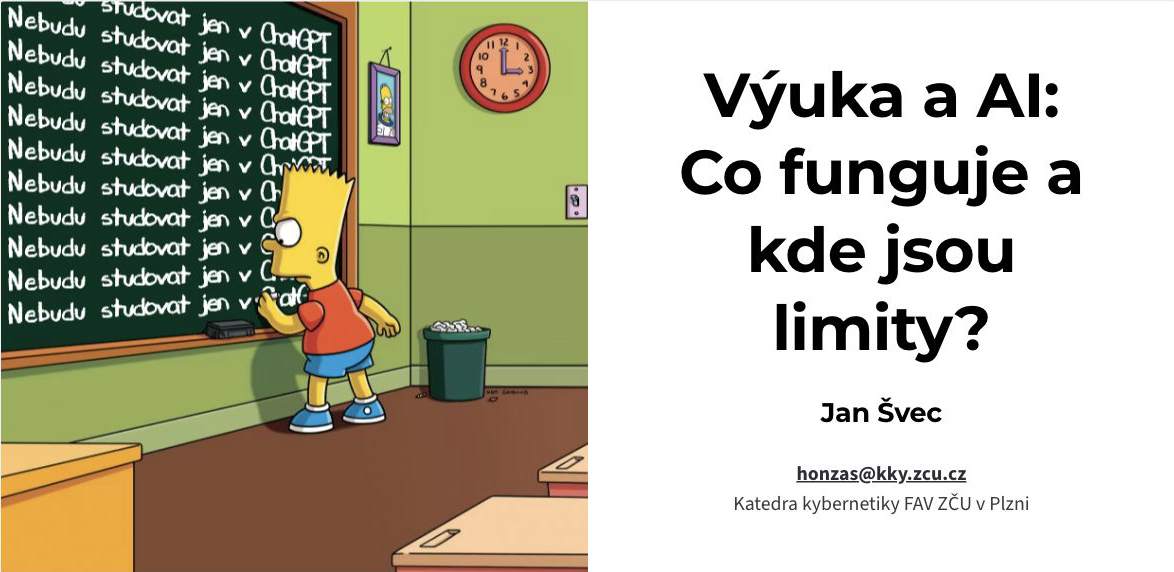
Abstract
The talk presented a practical workflow for processing a university lecture with automatic speech recognition and generative AI. A recording is converted into a text transcript, a chronological outline, a list of topics discussed beyond the slides and a glossary of technical terms. These materials can also provide the knowledge base for a specialised chatbot that explains course content and supports exam preparation. The second part examined AI as a first reviewer of teaching materials and spoken delivery. The discussion covered transcript quality, recording ethics, student privacy, human oversight and the limited options for evaluating the educational value of a Custom GPT.
Links
- Presentation slides: The presentation covers the lecture-processing workflow, prompt examples, a Custom GPT, benefits and limitations.
- Talk recording on the AI Monday Patreon: The video published by the organisers; access to the complete post requires AI Monday Patreon membership.
- AI Monday Pilsen #7 programme: The event programme with the presentation time, abstract, venue and speaker profile.
- Supplementary materials: A three-page practical guide to audio recording, UWebASR transcription, three reusable prompts for producing learning materials, Markdown-to-PDF conversion and Custom GPT configuration.
- UWebASR: The automatic speech-recognition service used in the presented workflow.
- Follow-up article about AI in the Internet Technologies course: Experience from the following semester connecting learning materials, student projects and transparent AI use.