Jan Švec | honzas.cz
Menu

Context-aware synthetic promoter design using neural networks enables rewiring of eukaryotic transcriptional networks

March 17, 2026 npj Systems Biology and Applications · journal-article

Synthetic biology needs better ways to design regulatory DNA while reducing the number of laboratory experiments. Our article in npj Systems Biology and Applications uses neural networks to find context-aware locations for inserting transcription-factor binding sites into promoters. The result connects machine-learning model design with biological constraints and experimental validation.
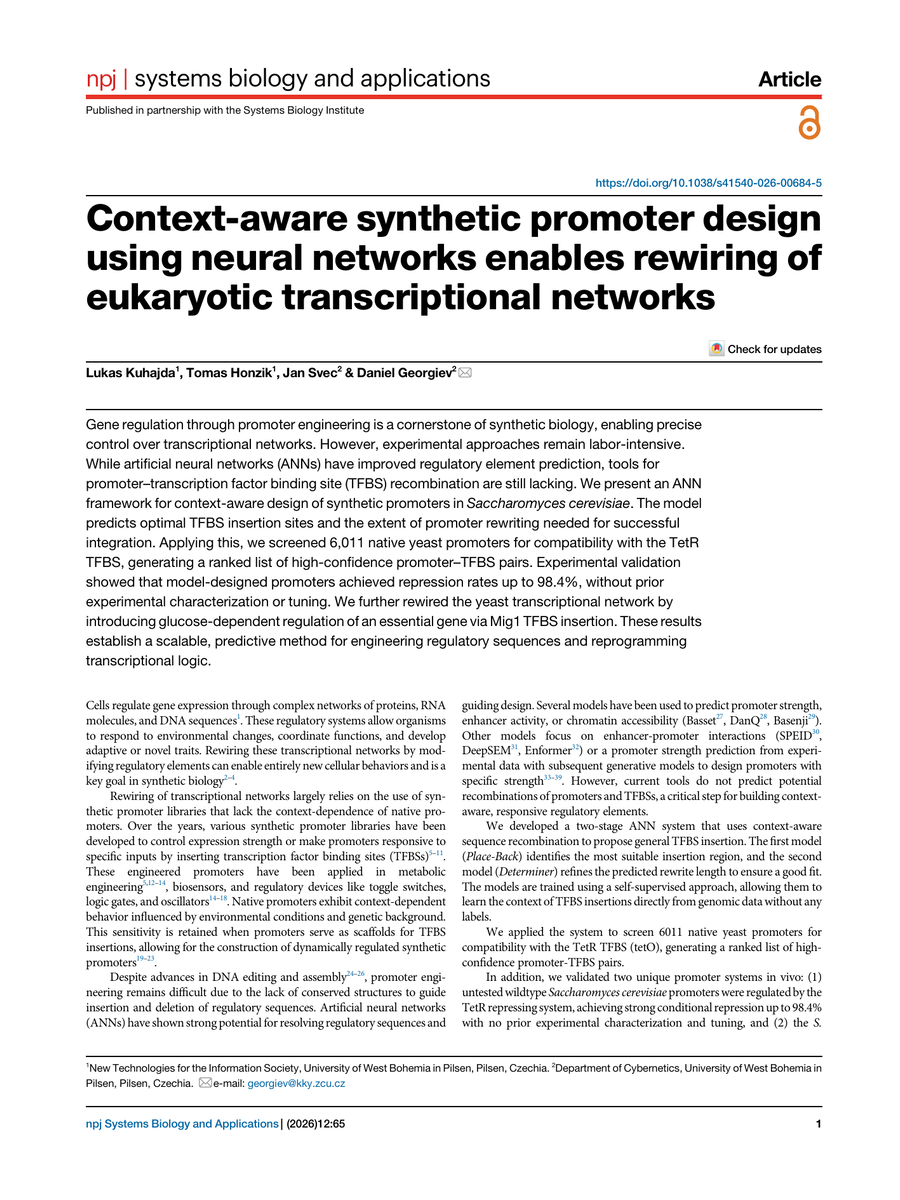
Portrait preview of the first page of the synthetic promoter paper

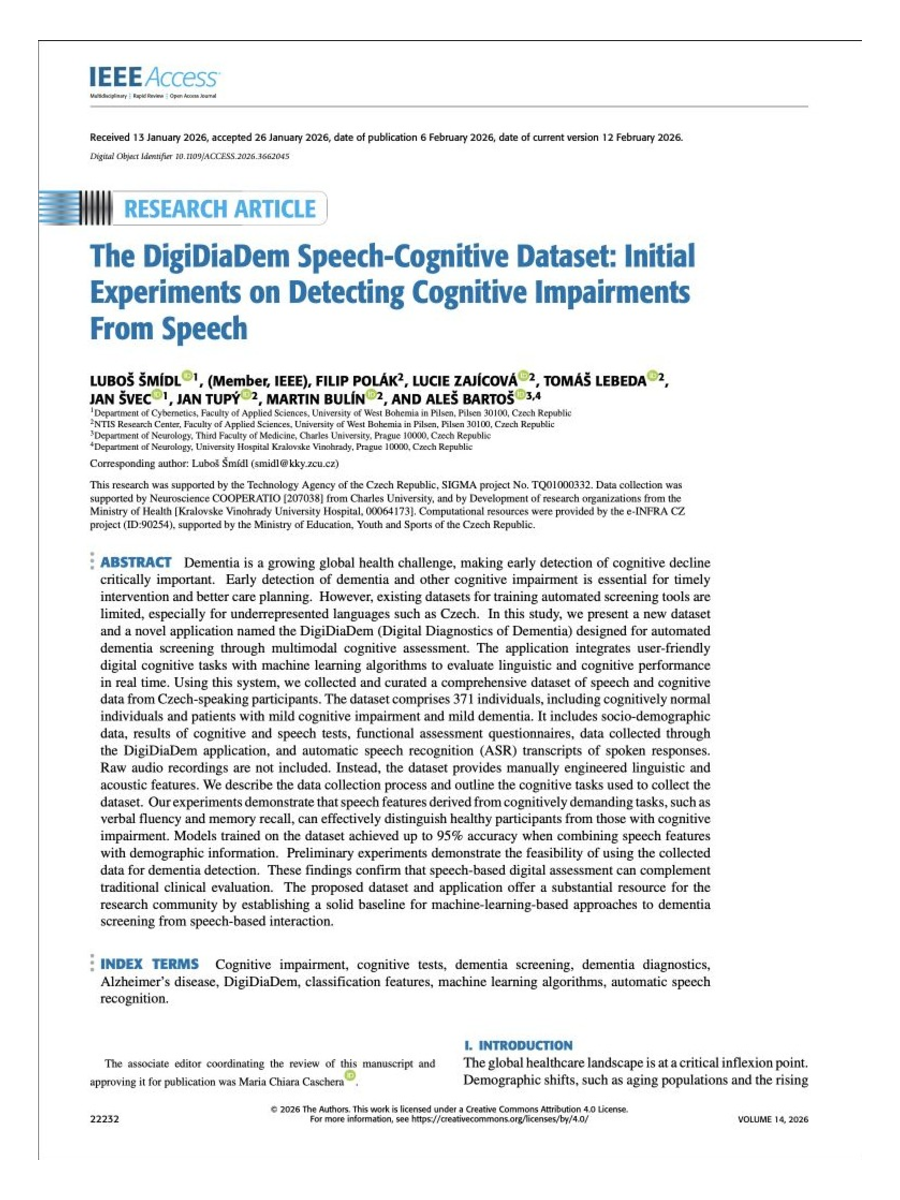
The DigiDiaDem Speech-Cognitive Dataset: Initial Experiments on Detecting Cognitive Impairments From Speech

February 6, 2026 IEEE Access · journal-article

Speech-based research into cognitive impairment needs datasets that connect carefully designed tasks, clinical context and reproducible evaluation. Our IEEE Access article introduces the DigiDiaDem Speech-Cognitive Dataset and the first experiments built on it. The work links dialogue-system design, speech recognition, data preparation and machine-learning evaluation within one research workflow.

Portrait preview of the first page of the DigiDiaDem dataset paper

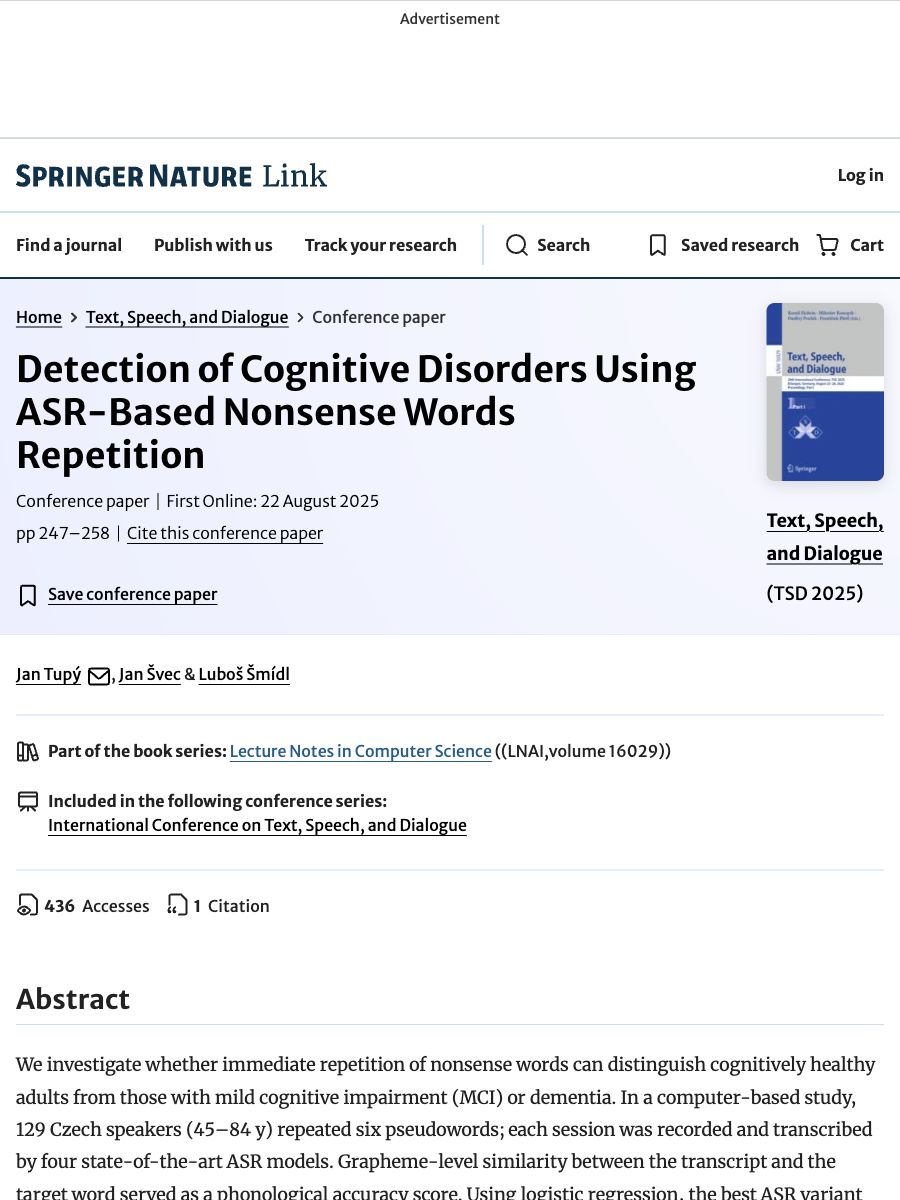
Detection of Cognitive Disorders Using ASR-Based Nonsense Words Repetition

August 22, 2025 Text, Speech, and Dialogue, TSD 2025, LNCS · conference-paper

Short speech tasks can reveal cognitive changes without requiring a long clinical interview. This paper examines whether automatic speech recognition can evaluate immediate repetition of nonsense words and distinguish healthy participants from people with cognitive impairment. The experiment shows why recognition errors, phonological similarity and the choice of language model all matter when speech technology becomes part of a screening method.

Portrait preview of the nonsense-word repetition paper

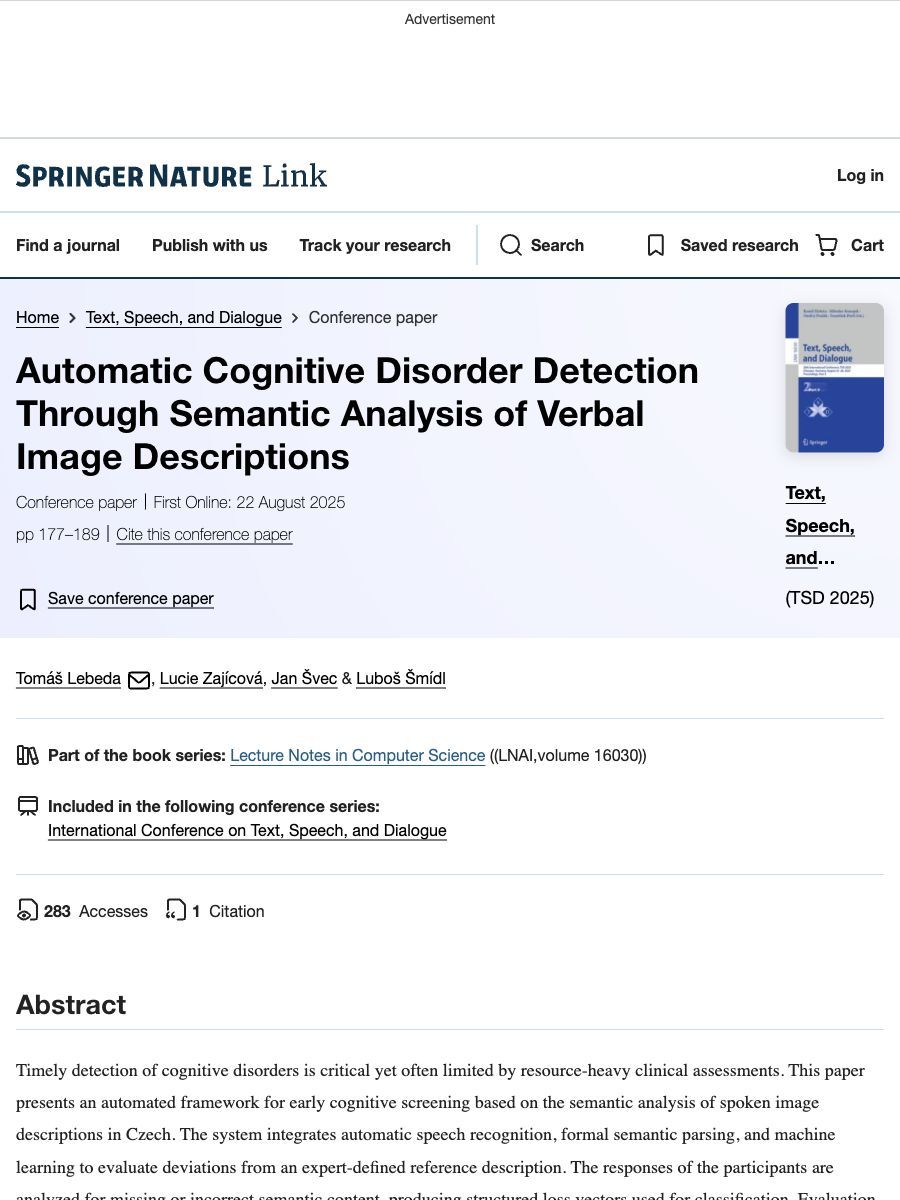
Automatic Cognitive Disorder Detection through Semantic Analysis of Verbal Image Descriptions

August 22, 2025 Text, Speech, and Dialogue, TSD 2025, LNCS · conference-paper

A spoken image description contains information about more than pronunciation: it also shows which concepts and relations a person notices and how they organise them in language. This paper combines speech recognition, formal semantic analysis and machine learning to compare Czech descriptions with an expert reference. The resulting semantic features offer an interpretable route towards scalable screening for cognitive disorders.

Portrait preview of the semantic image-description paper