Concern about memory can begin a long search for someone who will connect individual examinations and recommend the right next step. At Nezapomenutelný den paměti na Vinohradech, the DigiDiaDem team used an anonymised story resembling the Czech tale of the Little Hen and the Little Rooster to show how fragmented that journey can become. The case also demonstrated how a short digital prescreening can complement a standard assessment without replacing a clinical diagnosis.
I could not attend the related Cognitive Health Day at the Faculty of Applied Sciences, so I was glad to join the Vinohrady event with my colleagues from the DigiDiaDem project.
Like the Little Hen and the Little Rooster
One story from the programme stayed with me because it sounded like the Czech tale in which every answer creates another errand. An anonymised 77-year-old, concerned because of family history, first asked a general practitioner about memory testing. Further visits to psychiatry and neurology brought partial examinations, but no cognitive assessment that would connect the findings and answer the original concern.
The next specialist appointment was two years away. A health insurer could provide a list of facilities only by diagnosis, which the person understandably did not yet have. Online tests were easy to find, but difficult to interpret and too simple to offer confidence about what should happen next.
A second general practitioner eventually recommended the Memory Disorders Clinic at University Hospital Královské Vinohrady, where our teammate Aleš Bartoš works. Although the DigiDiaDem application can generally also be completed at home, this person used it at the clinic, before the standard assessment, in about eleven minutes. Its result did not provide a diagnosis; it identified a potentially concerning profile and recommended timely professional follow-up. The subsequent standard assessment broadly supported the need for that follow-up.
This is the practical gap DigiDiaDem is intended to address. A digital prescreening makes the first step accessible, gives the next conversation more structure and reduces the chance that a person keeps moving from one disconnected door to another. It remains an indicative tool and does not replace assessment by a physician. The research foundation, dataset design and initial speech-based experiments are described in our IEEE Access paper on the DigiDiaDem Speech-Cognitive Dataset.
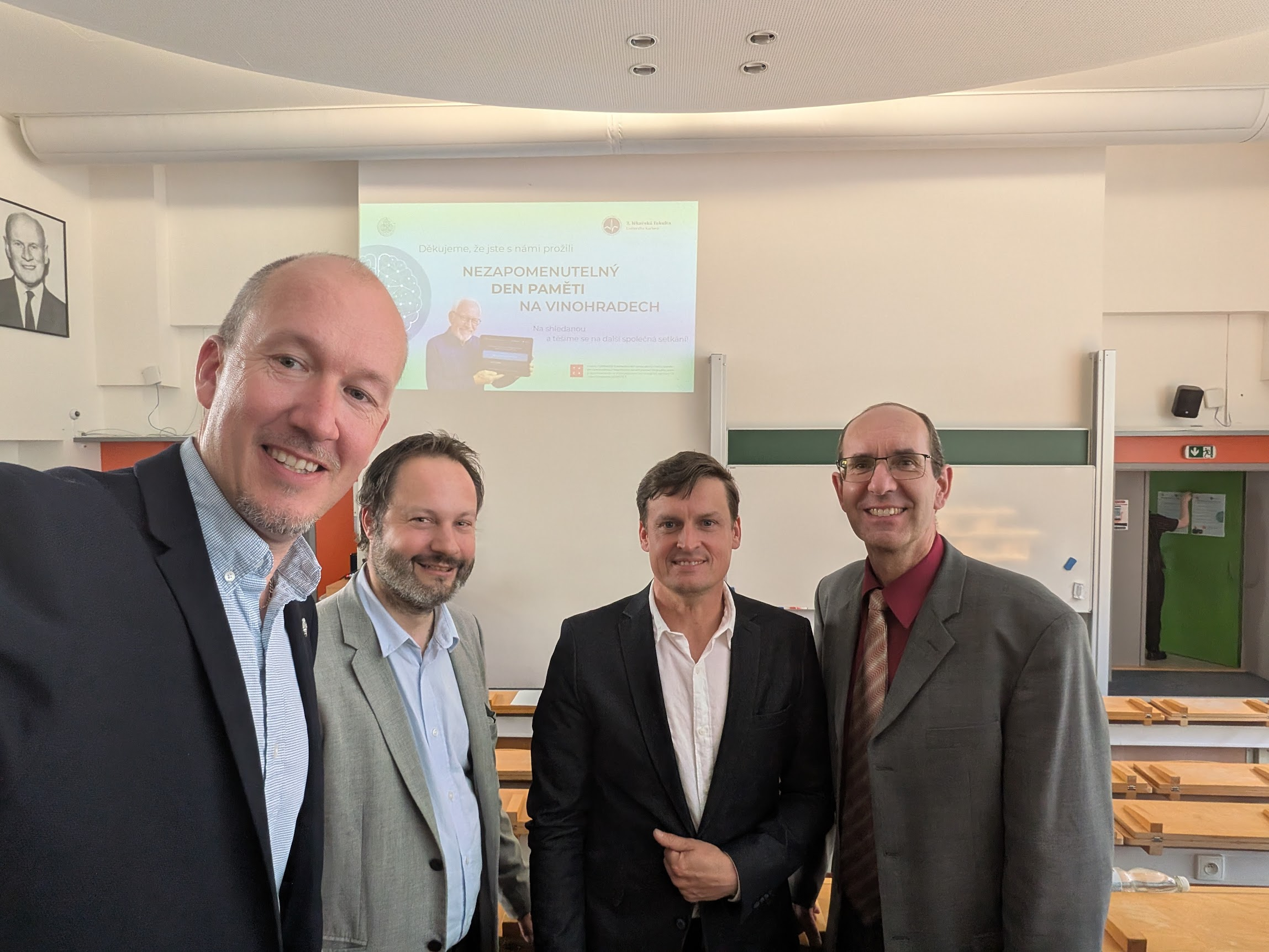
The photograph brings together me, Martin Víta, Luboš Šmídl and Aleš Bartoš, four colleagues from the project team. Thank you, Aleš, for organising the day, for the refreshments and for a programme packed with useful information. It was good to see the whole team together and to discuss DigiDiaDem in its wider clinical and public context.
Links
- DigiDiaDem application: Public online self-assessment of speech and memory developed by the project team.
- About DigiDiaDem: Project background, intended use and information for the public and physicians.
- Event materials: Public link list for the programme and materials from the Memory Day.
- Cognitive Health Day: Related public event at the Faculty of Applied Sciences, University of West Bohemia.
- Memory Disorders Clinic at FNKV: The specialist clinic connected with Aleš Bartoš and the clinical follow-up of people with memory difficulties.
- Martin Víta: Professional profile of a DigiDiaDem team member working at the intersection of data, medicine and technology.