Scanned archival collections are difficult to explore when full text and consistent metadata are missing. Our contribution at CLARIN, DARIAH & Libraries 2026 showed how we use large language models as a team to transcribe and enrich NATO archival documents. We presented the path from source scans to linked research materials, including researcher feedback and the limits of generated descriptions.
From a scan to a reading path
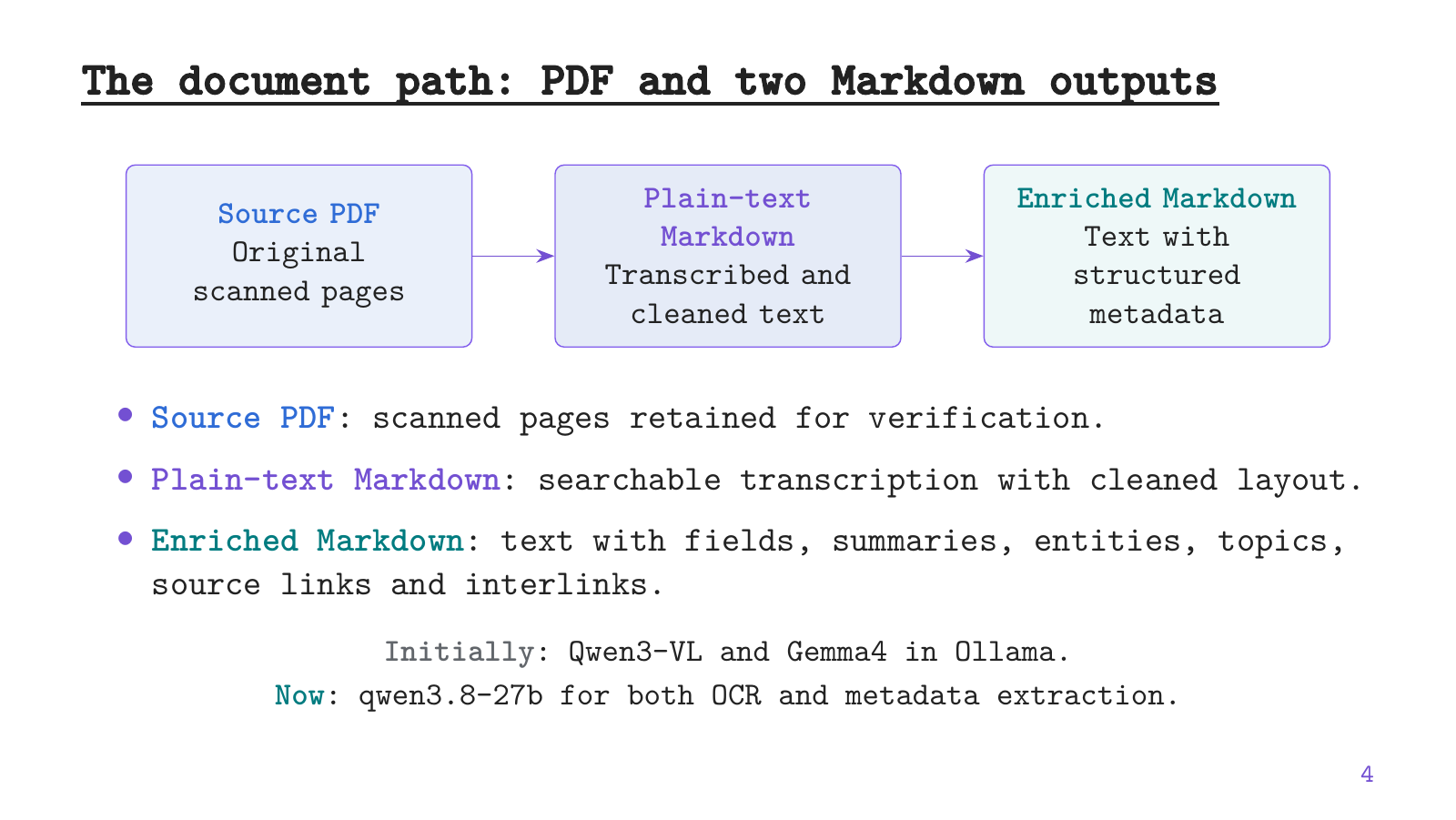
The collection includes declassified, publicly available English and French documents from NATO Archives and the NATO Library in Brussels. In the presentation, we followed a document through transcription, text cleaning and metadata extraction. The result combines searchable text with titles, dates, summaries, topics, entities and links to related records, while retaining access to the original scan for verification.
We work on metadata extraction as a team of three: me, from the Faculty of Applied Sciences at the University of West Bohemia; Lauren Sukin, from the Department of Politics and International Relations and Nuffield College at the University of Oxford; and Michal Smetana, from the Faculty of Social Sciences at Charles University, who is also a Visiting Fellow at All Souls College, Oxford. During my research stay in Oxford, we developed and validated the workflow together.
We also demonstrated how researchers can search the documents, follow references and collect selected texts for further work in Obsidian. This application lets users work with locally stored text notes and link them together. Researchers can read the processed documents, add their own notes and explore connections between sources.
We use Markdown as our shared data format: plain text with lightweight notation for document structure. It is compatible with Obsidian and is also popular for further processing in agentic AI workflows. This lets us use the same files for research reading and as input for AI agents.
What needs checking
Researcher feedback and document reviews were part of the talk. Generated summaries can help identify useful material, but they can also omit attachments or overstate what a document says. OCR mistakes can propagate into dates and references, so we keep the source PDF available for checking.
We also presented Archivatorium, the toolkit we develop with AI agents from written specifications. We use large language models for transcription, text cleaning and metadata extraction; we then use the extracted references to link related documents.
Presentation and workshop
We prepared Use of LLMs for metadata extraction from NATO archive documents for the CLARIN, DARIAH & Libraries 2026 Workshop at the National Library of the Czech Republic in Prague’s Klementinum. The workshop focused on making library collections usable for digital humanities and language research. Download the presentation slides as a PDF.
Links
- Presentation PDF: Complete 13-slide presentation, including document examples and researcher feedback.
- Workshop and programme: Official event page with the programme, venue and workshop organisers.
- Archivatorium: Source code and documentation for the document-processing toolkit.
- NATO Archives: NATO archival catalogue containing source documents.
- Lauren Sukin: Associate Professor of US Foreign Policy at the University of Oxford and a Professorial Fellow at Nuffield College.
- Michal Smetana: Associate Professor of International Studies at Charles University and a Visiting Fellow at All Souls College, Oxford.
- Obsidian: Application for locally stored text notes and links between them.